Cloud-Native Endpoint Security

QuickSecure
Autonomous Endpoint Detection & Containment

A standardized, cloud-managed endpoint security platform with edge-based ONNX inference, confidence-gated containment, multi-tenant isolation, and centralized AI security intelligence. Runs natively on Windows, Linux, macOS, Android, and iOS. Built for horizontal scalability and production-grade ML governance.

Start Free Trial Technical Documentation
What Is QuickSecure

The Product, in Plain Terms

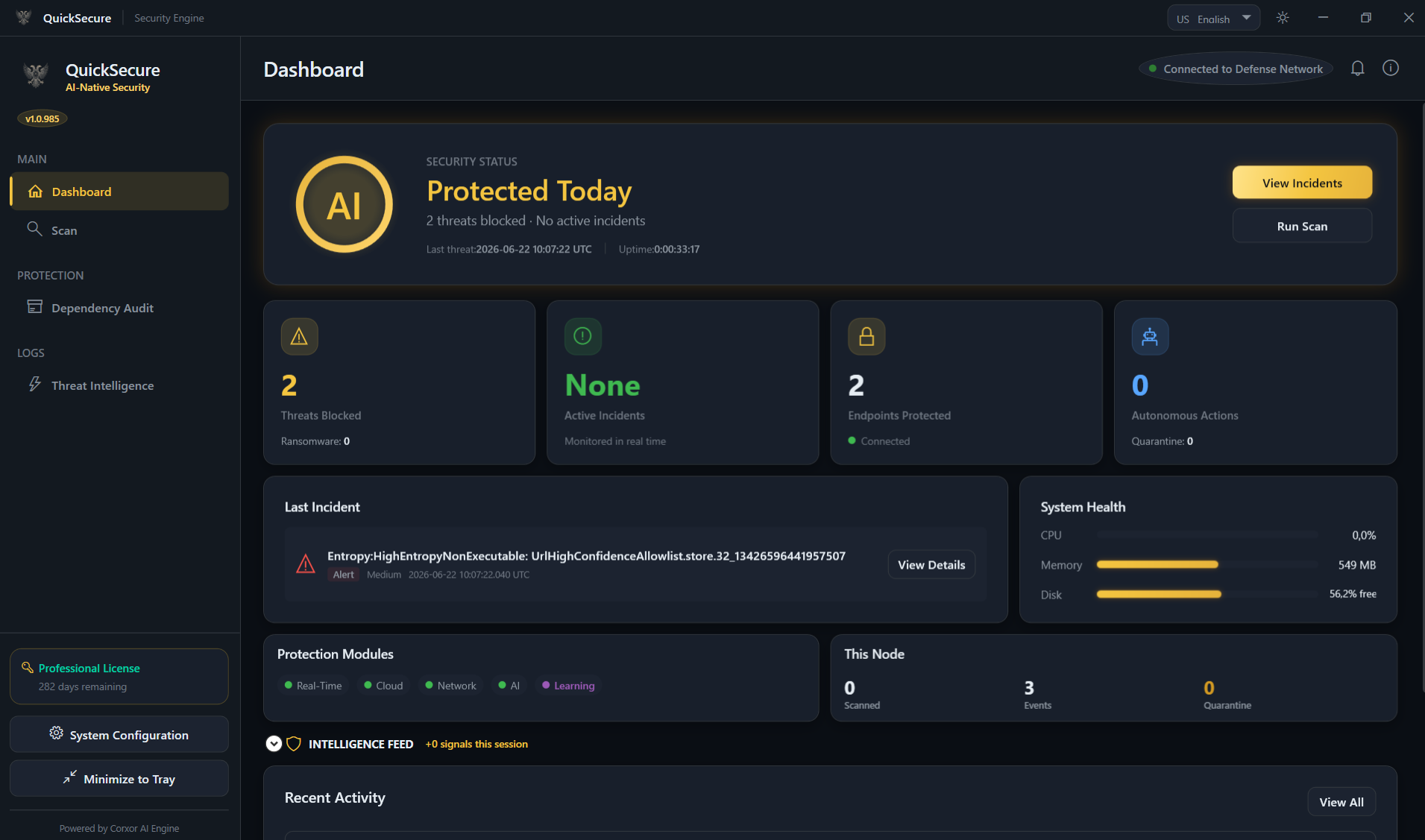
QuickSecure is a self-learning endpoint detection and response (EDR) product. A lightweight agent runs on protected systems — Windows, Linux, macOS, Android, and iOS — and monitors behavioral telemetry, persistence mechanisms, network activity, and file-system operations. It does this without installing kernel drivers, which eliminates the risk of system instability or BSOD events caused by the security agent itself.

When the agent detects suspicious activity, it evaluates the threat using a versioned ONNX machine learning model running directly on the endpoint. The model produces a composite risk score, a confidence level, and an explainable breakdown of which signals contributed to the classification. Based on these outputs, the operating mode, and the configured policy thresholds, the agent either logs the event, presents it for human review, or contains the threat autonomously.

The platform is delivered as a cloud-managed SaaS product. Every customer receives the same agent, the same ML engine, and the same cloud console. Configuration is handled through standardized policy settings, not custom code. Adding a new customer requires a new tenant record — not a new deployment, not a custom build, not an engineering project.

Core principle: The system is designed to scale first — not to be customized per deployment. Protecting 10 endpoints and protecting 10,000 endpoints use the same product foundation. Deployment topology may change. The product core does not.

AI Security Engine

Centralized Intelligence, Distributed Enforcement

QuickSecure is not just an agent that runs on endpoints. At its center sits a cloud-native AI security engine that continuously learns from fleet-wide telemetry, threat intelligence feeds, and labeled decision outcomes. Every endpoint contributes behavioral data. The central engine aggregates, correlates, and produces actionable intelligence that flows back to every agent in the fleet.

This creates a collective defense network: when one endpoint encounters a new threat pattern, the central engine evaluates it, and within minutes the entire fleet is updated with new Indicators of Compromise. The more endpoints participate, the stronger the detection capability becomes for everyone.

Zero Kernel Attack Surface

No kernel drivers. User-mode ETW and eBPF analysis provides deep process, network, and registry visibility without BSOD risk or system instability.

Versioned Model Registry

Every ONNX model is versioned, signed, and tracked. Full lineage from training data to production deployment. Rollback to any previous version in seconds.

Explainable Decision Logic

Composite risk score with per-feature contribution breakdown. Model version, policy threshold, and confidence level recorded per decision. No black-box verdicts.

Drift Monitoring (PSI)

Population Stability Index tracks distribution shift between training and production features. Automatic retraining triggers when PSI exceeds configurable thresholds.

Canary Deployment

New model versions are validated on a subset of endpoints before fleet-wide promotion. Canary traffic percentage and rollback criteria are policy-defined.

Three-Stage Fallback

ONNX edge model → Random Forest → rule-based heuristics. If the primary model fails or confidence is insufficient, fallback stages engage automatically.

End-to-End Architecture

How It Works — From Agent to Control Plane

QuickSecure operates across six coordinated layers. Each layer has defined responsibilities, clear boundaries, and independent failure domains.

Agent
Edge Inference
Detection
Confidence Gating
Containment
Policy-Controlled
Control Plane
Tenant Isolation
SIEM Routing
Outbox Pattern
AI Engine
Collective Intel

Endpoint Layer (Agent)

A lightweight agent runs on protected systems across desktop (Windows, Linux, macOS) and mobile (Android, iOS) platforms. It collects behavioral telemetry, persistence indicators, network signals, and other high-signal forensic checkpoints — over 150 data points per evaluation cycle. Inference is performed locally using versioned ONNX models. Decisions are evaluated against policy thresholds and operating mode constraints before any containment action is taken.

Detection & Inference Pipeline

Each event passes through a structured, safety-first decision pipeline. The primary path uses the ONNX edge model. If confidence falls below threshold or model validation fails, a fallback Random Forest engages. If that also yields insufficient confidence, rule-based heuristics provide a deterministic final safeguard. Every decision produces a composite risk score, model confidence, explainable feature contributions, and recorded model version and policy context. Containment is never blind. It is policy-controlled and confidence-gated.

Cloud Control Plane & SIEM Routing

The control plane governs tenant isolation, policy assignment, operating modes (Shadow, Supervised, Autonomous), and event routing. Three routing modes are supported: CentralOnly (Corxor Central), DirectOnly (customer SIEM), and Hybrid (dual delivery). The routing engine uses a transactional outbox pattern with exponential backoff, dead-letter queues, per-tenant rate limiting, and fault isolation. Webhook, Syslog (CEF), and Microsoft Sentinel are supported.

Central AI Security Engine

The centralized AI engine aggregates threat intelligence from the entire endpoint fleet. It manages model governance — registry, signing, canary deployment, drift monitoring (PSI), and rollback. It processes labeled decision outcomes (TP/FP/FN/TN) to continuously improve model accuracy. It distributes Indicators of Compromise across all tenants, creating a collective defense posture that strengthens with every new endpoint in the network.

Cloud-Native SaaS Scalability

Multi-Tenant by Design, Not by Retrofit

The default deployment model is cloud-managed SaaS. The architecture uses strict multi-tenant data partitioning, horizontal scaling of control plane components, centralized model governance, and shared infrastructure with isolated tenant contexts. There is zero per-customer code divergence.

🔒 Tenant Isolation

Each tenant gets dedicated data partitions, per-tenant ML model governance, per-tenant SIEM routing, and isolated policy contexts — all on shared infrastructure.

📈 Horizontal Scaling

Control plane components scale independently. Adding customers scales linearly — no re-architecture, no dedicated infrastructure per tenant unless explicitly requested.

🚫 Zero Custom Code

No per-customer forks, branches, or custom builds. Configuration-driven differentiation only. Consistent quality, faster updates, and lower operational cost.

Why this matters: Many security vendors position themselves as "cloud-native" while requiring per-customer deployment engineering. QuickSecure's tenant onboarding is a database record and a policy assignment — not an infrastructure project.

Detection & Operating Modes

Progressive Trust — Earned, Not Assumed

The agent monitors over 150 forensic checkpoints covering persistence analysis (WMI, COM hijacking, registry, scheduled tasks, systemd/cron), behavioral detection (process hollowing, LSASS access, credential dumping, LOLBins, fileless malware), network intelligence (C2 beacons, DNS tunneling, AbuseIPDB/URLHaus/MalwareBazaar integration), and supply chain defense (git scanning, CI/CD integrity, typosquatting, secret exposure).

Organizations progress through three operating modes as confidence in detection accuracy grows:

Shadow

Observe Only

Full inference pipeline runs, zero containment actions taken. Compares "would-contain" vs "actually-contain" to validate model accuracy before enabling autonomous behavior.

Observe
Supervised

Human-in-the-Loop

Detections generate recommended actions. An admin reviews, approves, or dismisses each one. Every decision enriches the TP/FP labeling system for model retraining.

Verify
Full Autonomous

Confidence-Gated

When confidence exceeds policy threshold and risk criteria are met, containment executes automatically. Every action is logged, reversible, and feeds back into the learning loop.

Autonomous
Platform Resilience

Built to Survive Hostile Environments

An endpoint security product that crashes under load, loses events during outages, or allows tampering of its decision logs is worse than no product at all.

Self-Healing

Automatic recovery under degradation. The agent restores state without manual intervention when services are lost.

Backpressure

Adaptive circuit breakers prevent telemetry overload from freezing containment decisions.

Tamper-Evident

Cryptographic integrity on every event, decision, and config change. Unauthorized modifications are flagged.

ML Integrity

Model poisoning protection via signatures, drift monitoring, and canary validation.

No Vendor Lock-in

Deployable on-premise, hybrid, or multi-cloud. Architecturally independent from any single provider.

Deployment & Service Model

SaaS Default — Sovereign Optional

The primary deployment model is cloud-managed SaaS — fastest path to protection, first to receive updates. For regulated or sovereign environments, QuickSecure also operates in dedicated single-tenant infrastructure, on-premise data centers, sovereign cloud environments, and hybrid configurations.

The product core does not change across deployment models. The detection engine, inference pipeline, ML governance, and containment logic remain identical. Infrastructure ownership and data residency change. The security product does not.

Product vs. Service Layer

QuickSecure is the product. It includes its own SOC console — incident review, risk scoring, model confidence visualization, audit trails, policy management, and fleet intelligence — without external tooling.

Corxor MSSP is an optional operational layer. Customers may run QuickSecure independently, integrate with their internal SOC, engage Corxor as MSSP, or use it via third-party MSSP partners through multi-tenant white-label support. The platform architecture is independent from the service model.

Pricing

Transparent Per-Endpoint Pricing

Same product at every tier. Capability level and support SLA differ.

INSTANT ACTIVATION
Personal
$12.99 / mo
Up to 3 devices · Monthly · Cancel anytime
  • Shadow + Supervised modes
  • Basic SOC console view
  • Explainable AI scoring
  • Collective IoC sync
  • 90-day event retention
  • Email support (48h SLA)
Enter License Key
Business
$8 / endpoint / mo
Annual commitment · Min. 25 endpoints
  • Shadow + Supervised modes
  • Built-in SOC console
  • Explainable AI scoring
  • Collective IoC sync
  • 90-day event retention
  • Email support (24h SLA)
  • JSON export + Webhooks
Get Started
Enterprise / MSSP
Custom
Tailored to your organization
  • Everything in Advanced
  • Enterprise tenant isolation
  • Tenant-dedicated ML models
  • Multi-tenant SOC dashboard
  • Direct SIEM export (Sentinel, Splunk, Syslog)
  • Per-tenant rate limiting
  • On-premise deployment option
  • Custom retention & dedicated support
Contact Sales

Volume discounts available for 100+ endpoints. First-year pricing guaranteed for annual commitments.

Technical FAQ

Questions from CTOs, Architects & SOC Leaders

Does the agent require kernel drivers?
No. QuickSecure operates entirely in user-mode using ETW (Windows) and eBPF (Linux). No kernel drivers installed, eliminating BSOD risk. The detection model compensates for narrower visibility using behavioral correlation across 150+ data points.
What happens with false positives in autonomous mode?
Every autonomous containment action is reversible. Full context is logged — model version, confidence score, feature contributions, policy threshold. The false positive is labeled and fed back into the retraining pipeline. Confidence thresholds can be adjusted per policy.
How is tenant data isolated?
Tenant isolation is enforced at the database level using global query filters. SIEM routing uses per-tenant queues with independent rate limiting and circuit breakers. ML governance supports per-tenant model versions. No shared state between tenants at the application level.
What if the ONNX model fails to load?
Three-stage fallback: ONNX → Random Forest → rule-based heuristics. The final stage is deterministic and requires no ML runtime. The fallback stage used is recorded in every event. The control plane is notified of model failures for operational alerting.
How does drift monitoring work?
Population Stability Index (PSI) compares production feature distributions against training data. When PSI exceeds the threshold (default 0.2), the system triggers retraining, flags for review, or rolls back — depending on policy. Full feature statistics are stored for post-hoc analysis.
Can we integrate with our existing SIEM?
Yes. CentralOnly, DirectOnly, or Hybrid routing. Webhook (JSON), Syslog (CEF), and native Microsoft Sentinel integration supported. Transactional outbox pattern with retry logic and dead-letter queues for guaranteed delivery.
Is the product the same across SaaS and on-prem?
Yes. Detection engine, inference pipeline, ML governance, containment logic, and SOC console are identical. On-premise deployments receive the same model updates (signed artifacts), same agent versions, same policy engine. No on-prem-specific code branches.
What is the agent's resource footprint?
Typical memory under 80MB, CPU under 2% during normal operation on desktop platforms (Windows, Linux, macOS). On mobile (Android, iOS) the agent is optimized for battery efficiency with adaptive scan scheduling. ONNX runs on CPU, no GPU required. No kernel drivers, no high-I/O background services. Telemetry is batched and transmitted at configurable intervals.
How does the collective defense network work?
When any endpoint in the fleet encounters a new threat pattern, the central AI engine evaluates it, generates Indicators of Compromise, and distributes them across all tenants. Threat intelligence is aggregated, anonymized, and shared — every endpoint benefits from the fleet's collective experience.
Can MSSP partners white-label QuickSecure?
Yes. Enterprise/MSSP tier supports multi-tenant management. MSSP partners onboard clients as sub-tenants with isolated data, independent policies, and separate SIEM routing. Same underlying product — no custom builds per partner.

Get Started

Start with a 14-day free Business trial — up to 10 endpoints, no credit card required.

Personal: Instant activation — up to 3 devices, $12.99/mo. Business / Enterprise: 14-day free trial — dedicated onboarding included.
Start Free Trial Book Technical Demo Enterprise Sales